

train dreams
our choice of which future we water is irreversible, not inevitable.

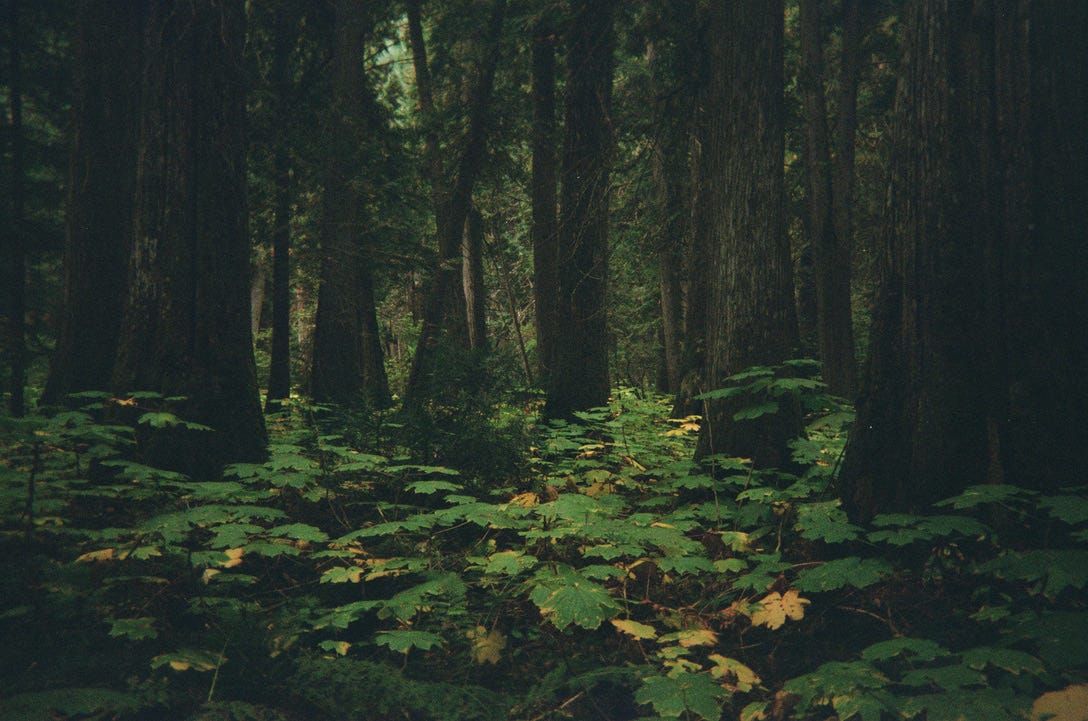
When I was home last, I watched Train Dreams, an adaptation of Denis Johnson’s novella, which recounts the story of Robert Granier. It’s largely a silent narrative, and the absence of noise builds a weighty stand‑in for the vast, indifferent scale of the landscape that doesn’t care if the man lives or dies. Granier swings an axe and lays track through the same ancient forest where I grew up. By the end of the film, he cannot say whether he was a maker or a destroyer, and on the frontier, the film reminds us, those two things are never separate.
My great‑great‑grandmother arrived in Oregon in a wagon, travelling into the unknown from the hills of Appalachia. She set her roots there, and they mingled deep with the old growth firs, living long enough to become a story my family can still tell firsthand. My mother was born into a world where Armstrong had already stepped onto the moon, and still remembers her, an old woman who outlived the mule and the washtub and the kerosene lamp and saw it turn strange and electric, beige plastic computers sat next to the salt shakers and colour spilling onto the television screen.
She witnessed highways cut straight through valleys that used to follow the river, aeroplanes crossing landscapes where her brothers had laid tracks. Like Granier, they all did what people of her making have always done. She witnessed, treating her life not as a thing to be optimised, but as something to be borne and endured as it passed—an irreversible stream of images, each frame yielding the next, though she could not predict how the story would close.
The folks back home know that when a hillside burns or a valley gets cut up, nobody is being punished and nobody is being spared. Even decades after my ancestors reunited with the creatures of the forest in soft soil, the wildfire and logging and railroads still ran on the same appetite, and the old‑timers will say, “that’s when everything changed.” We’re the descendants of people who endured the world and, without asking where the next step led, built the conditions that shaped it.
If you read the old newspapers, the railroad is both a “ruthless invader of paradise” and the thing that will finally connect you to the rest of the world. Beautiful and catastrophic, these are the instruments that sacrifice existing and possible worlds and tear out space for the new future we can’t quite see.
We grant fire and flood the dignity of irreversibility. Our tools—the axe, the railroad, the platform—often exceed our capacity to attend to their consequences, and we know it.
But in retrospect, the settlement of the West has been overlaid with a second story. The lived reality of the frontier was a gamble under radical uncertainty, a zone of risk, chance, and improvisation where nothing about survival or prosperity was guaranteed.
The other story, Manifest Destiny, turned that gamble into gospel. It said the land was always meant to be ours, that the rails were laid by providence, not by men who could have chosen differently. There’s a comfort in that—a deep, bone-settling relief in believing you were carried by fate rather than making bets you couldn’t take back. It eases the weight of what was destroyed, because if it was destined, then no one had to choose it. The contingent becomes inevitable only in the telling, when we need it to have been.
I can’t help feeling our technology stories have followed the same arc, drifting from frontier to destiny. Many people I meet believe that some form of artificially intelligent system will rapidly speed up a capability curve and down a cost gradient; that the coupling between energy, matter, and computation is tightening on a trajectory that looks pretty fixed across most reasonable forecasts.
I mostly agree. Every irreversible step we take constrains the adjacent possible and forecloses other worlds we will never see. But that doesn’t make the next step forward known. In Stuart Kauffman’s language, each major invention is a new “actual” that opens an unprestatable adjacent possible: a branching fan of futures that did not exist before, but that are still radically contingent. The fact that we cannot list those futures in advance does not mean there was only one route into them.
These recognitions of our contingent moment are increasingly equating irreversibility and momentum with inevitability. We slide from “there’s no going back once we decide” to “there is never any other way.” Borrowing the old word, we call LLMs and crypto and whatever‑comes‑next “the frontier,” but our proclamations borrow from the way we spoke of manifest destiny; the coming of certain futures are a settled law, a train on rails.
The word frontier once meant something different, the “hither edge of free land,” the place where you could escape the constraints of the old order and try again. It was “a wide‑open land of unlimited opportunity,” the place where forces beyond your control might shape the outcome but in doing so ensured it was never guaranteed. You went west to start a world that didn’t yet exist, knowing you might just as easily vanish.
The loudest voices today hold up their manifestos like tablets and swear that the map is already drawn. They never admit that the ink is still wet and the pages are their own.
We are not fools. We all know, on some level, what we’re doing and the slop we’re building. But the narrative offers us something we desperately want promising that we may lay down the unbearable questions about what world we’re making and where, if anywhere, we belong inside it. Destiny even gives us a kind of scoreboard, where we can prove our genius by playing the game well instead of imagining there might be another. We no longer have to wrestle with meaning in the dark; we can hand it over to the declarants of the inevitable and return to the safer work of optimisation, which can only fail by degrees, unlike imagination, which can fail in kind.
A true frontier demands harder questions: what kind of world is worth all this burning and cutting and wiring-up? What futures are we willing to foreclose so that another can exist? Every stretch of track we sink into the hillside kills off a whole country of might-have-beens and ushers in a tangle of new paths we can’t see clearly yet. But when we’re told it’s destiny and our god-given right to reap its rewards if only we get there fast enough, the question narrows to “how do I build it first?” — and that question is so much more comfortable to live inside than building without knowing whether you’re building toward salvation or ruin, swinging the axe without the consolation that someone wiser has already decided this tree needed to fall.
It’s possible the consensus is right, and the tracks may well run the way the forecasters say. But if we can sit with the terror of not knowing and build anyway, then the machine becomes what it has always wanted to be at its best: not destiny, but a way of giving more good worlds a chance to exist. The answer is not to throw the tools away, but to aim them at work we won’t be ashamed to have made irreversible. It is not the evil of the tools that will damn us, but the poverty of our quests.
Our choices help decide which worlds become real and which remain hypothetical. We owe the work its full seriousness. For better or worse, our instruments only bite into earth along the paths we care to mark.
So we choose where to sink the pilings, which hillsides to open, which lines to run. We choose rather than abdicate, because decades later, like Granier, you may well find yourself looking down at what you’ve built from the window of a plane. You will see the old cuts in the country: rails gone the colour of dried blood, hillsides charred by wildfire the same red‑brown, two versions of the same wound.
From that height it is easy to pretend these marks were always here, that the world was meant to look this way, that the valley we chose was the obvious direction, to forget it was hands and not prophets who swung the axes and drove the spikes, and to mistake the pattern for a plan.
Long after you have left this earth, your tracks will be only another layer of sediment in the story. Oxygen will get to work, fast in the flames and slow along the steel, stripping things down and leaving the soil laced with iron. The scoreboard will go dark, your name erased, and all that will be left are the scars to tell of your brief, fallible participation in deciding which futures were given a chance to live.
When your great‑great‑grandchildren walk that ground, whatever hums above and grows below in the tracks will be an expression of the world that goes on making new forms from old wounds, one of the many unprestatable universes that no one, not even the builders, could have foreseen.
love this Elena